Jeffrey Epstein &
United States Virgin Islands Economic Development Commission
Government Economic Development Agency, USVI
Key Facts
90% exemption on personal and corporate income taxes, 100% exemption on gross receipts and excise taxes
Tax Reduction Rate
USVI Economic Development Commission Statutory Guidelines
Over $300 million over two decades
Total Estimated Tax Savings
USVI Department of Justice Civil Complaint (2020)
$105 million plus 50% of the proceeds from the sale of Little St. James and Great St. James
2022 Estate Settlement Value
USVI Attorney General Settlement Notice (2022)
Southern Trust Company Inc. (preceded by Financial Trust Company)
Key EDC Entity
USVI Corporate Registry Filings
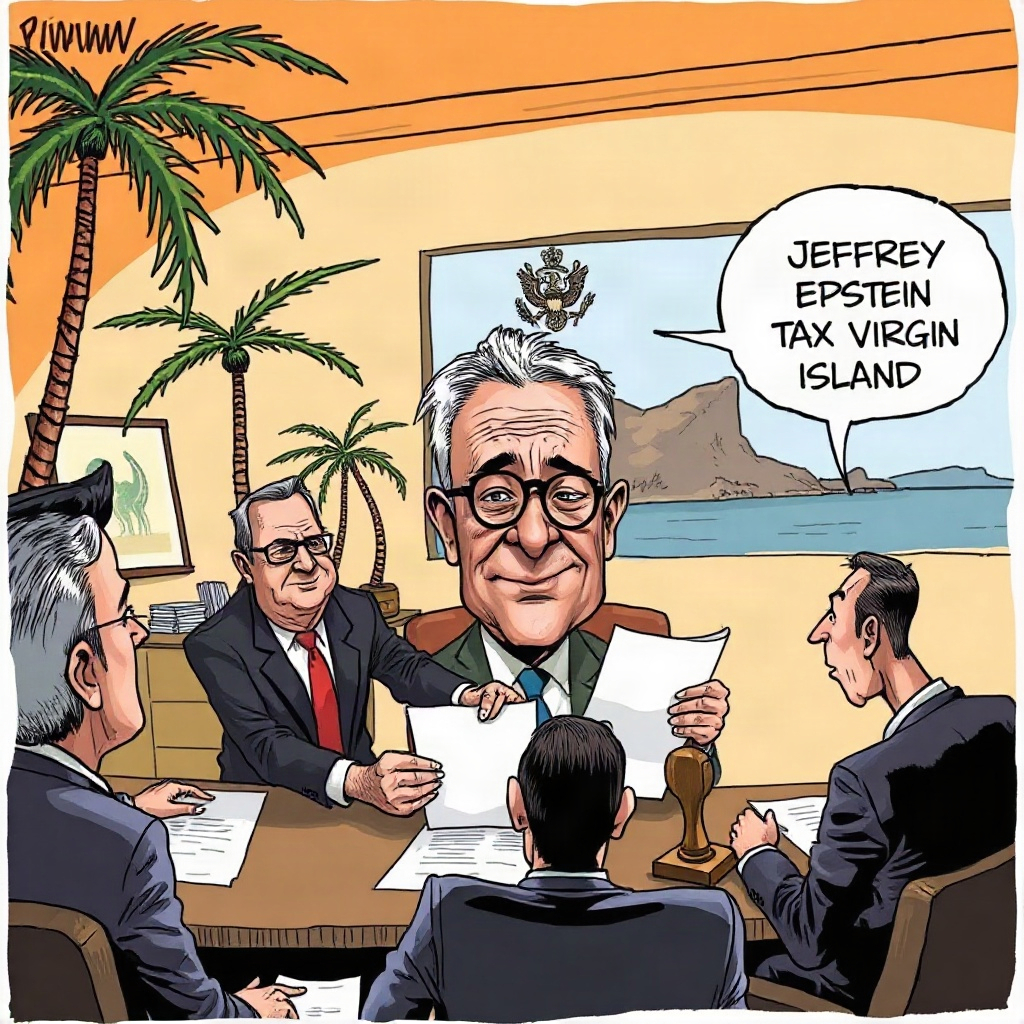
United States Virgin Islands Economic Development Commission · Government Economic Development Agency, USVI
For more than two decades, the United States Virgin Islands offered Jeffrey Epstein far more than an isolated Caribbean redoubt; it provided an institutional sanctuary anchored by the territory's highest executive offices. Central to this arrangement was the United States Virgin Islands Economic Development Commission, an arm of the Economic Development Authority charged with attracting outside investment to the archipelago. Through the commission, Epstein engineered an extraordinary tax shelter that funneled billions of dollars through St. Thomas while simultaneously subsidizing the logistical machinery of his sex trafficking network. What public officials defended for years as legitimate economic development emerged in post-mortem litigation as a calculated exploitation of territorial statutory loopholes, enabled by lucrative political relationships and an absence of regulatory oversight.
The Economic Development Commission was created by the territorial legislature to stimulate job growth, infrastructure investment, and local commerce in St. Thomas, St. John, and St. Croix. In exchange for establishing local corporate headquarters, hiring local residents, and contributing to territorial charities, approved businesses received what amounted to one of the most generous tax subsidies under American jurisdiction: a ninety percent exemption on personal and corporate income taxes, alongside a total waiver of gross receipts, property, and excise taxes. For legitimate businesses, the program provided a critical incentive to offset the steep logistical costs of operating in an isolated island territory. For Epstein, it served as a sovereign tax shelter, allowing him to legally shield hundreds of millions of dollars from federal taxation under the auspices of territorial economic development.
Epstein’s formal engagement with the commission began in the late 1990s through the establishment of Financial Trust Company, a purported financial consulting firm based out of Red Hook on St. Thomas. Territorial records and legislative audit disclosures show that Epstein easily secured initial tax benefits by promising significant capital infusions into the local economy. Even after his 2008 conviction in Florida for procuring a child for prostitution, the machinery of the territorial government did not withdraw its hospitality. Instead, when Financial Trust Company’s decennial benefits neared expiration, Epstein formed a new entity, Southern Trust Company, in 2011. Marketed as a state-of-the-art informatics and algorithmic consulting company, Southern Trust offered an ultra-modern veneer that diverged sharply from Epstein’s prior operations, allowing him to petition the commission for a brand-new, twenty-year tax abatement agreement.
Related articles
Jeffrey Epstein and Central Intelligence Agency (CIA)
An investigative review of alleged ties between Jeffrey Epstein and the CIA, examining FOIA filings, Acosta's remarks, and official calendar records.
Read article →

Jeffrey Epstein and Federal Bureau of Investigation (FBI)
An investigative analysis of Jeffrey Epstein's decades-long history with the FBI, from the 2006 Palm Beach probe to the 2019 Manhattan raid and FOIA files.
Read article →

Jeffrey Epstein and Secret Intelligence Service (MI6)
Investigative analysis of Jeffrey Epstein's alleged links to Britain's Secret Intelligence Service (MI6), Ghislaine Maxwell, and elite UK networks.
Read article →

Jeffrey Epstein and Directorate-General for External Security (DGSE)
Investigating allegations and public records regarding Jeffrey Epstein, his Paris operations, and France's foreign intelligence agency, the DGSE.
Read article →