Key Facts
U.S. District Judge, Southern District of Florida (Appointed 1997)
Judicial Post
Federal Judicial Center
Presided over civil victim litigation randomly assigned to his docket in West Palm Beach
Nature of Epstein Link
Southern District of Florida Dockets
Dismissed following voluntary out-of-court settlements under Rule 41
Civil Case Dispositions
Court Filings (2009–2010)
None substantiated across DOJ reports, court dockets, or journalistic investigations
Personal/Social Ties
DOJ OPR Report (2020)
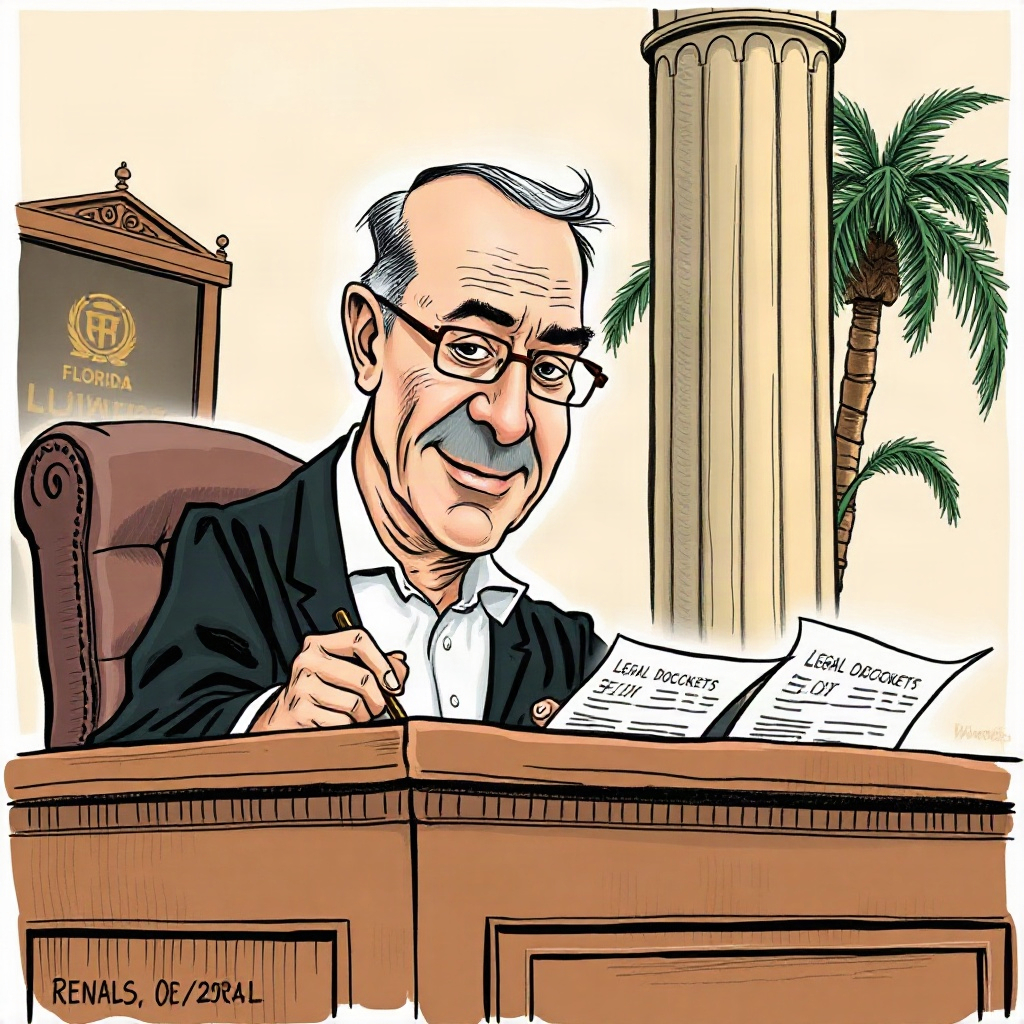
Judge Donald M. Middlebrooks · U.S. District Judge, Southern Florida
In the extensive web of judicial proceedings surrounding Jeffrey Epstein, dozens of state and federal jurists have handled matters concerning the late financier's criminal conduct, financial architecture, and civil liabilities. Among the federal judges whose dockets intersected with Epstein and his network is Donald M. Middlebrooks, a United States District Judge for the Southern District of Florida. Sitting in the West Palm Beach division—the federal jurisdiction encompassing Epstein's waterfront compound on El Brillo Way—Middlebrooks presided over critical early civil actions arising from the multi-agency investigations into Epstein's sexual abuse of underage girls. While public interest and political controversy have periodically drawn attention to Middlebrooks' bench, public records demonstrate that his connection to Epstein was strictly formal, defined entirely by random judicial case assignment and routine federal motion practice.
Appointed to the federal bench in 1997 by President Bill Clinton, Middlebrooks brought decades of South Florida legal experience to the federal judiciary, having previously served in private practice, as a governmental attorney, and in leadership roles within the Florida Bar. By the mid-2000s, Middlebrooks was one of the resident federal judges at the Paul G. Rogers Federal Building and U.S. Courthouse in West Palm Beach. This courthouse sat just miles from Epstein's residence, which local law enforcement had begun investigating in 2005 following a complaint lodged by the parents of a fourteen-year-old girl. When the Palm Beach Police Department's probe escalated into a federal investigation led by the Federal Bureau of Investigation, the Southern District of Florida became the primary legal battleground for Epstein's defense team and his victims.
Following the controversial 2007 non-prosecution agreement brokered between Epstein's defense attorneys and then-U.S. Attorney R. Alexander Acosta, Epstein entered a state guilty plea in June 2008 to two counts of solicitation of prostitution, including one involving a minor. While the non-prosecution agreement shielded Epstein and named potential co-conspirators from federal criminal prosecution, it did not extinguish civil liability. In late 2008 and throughout 2009, attorneys Bradley J. Edwards, Paul G. Cassell, and Stuart Mermelstein initiated a series of civil lawsuits on behalf of Epstein's victims. Due to the district court's random assignment system, several of these civil actions landed on the dockets of different Southern District judges, including Middlebrooks, Kenneth A. Marra, and Kenneth L. Ryskamp.
Related articles

Jeffrey Epstein and Darren K. Indyke
Investigative profile of Darren K. Indyke, Jeffrey Epstein's longtime personal attorney, corporate architect, and co-executor of his estate.
Read article →

Jeffrey Epstein and Richard D. Kahn
Investigative profile of Richard D. Kahn, Jeffrey Epstein's long-time accountant and co-executor of his multi-million-dollar estate.
Read article →
Jeffrey Epstein and Michael F. McAuliffe
Investigative review of Michael F. McAuliffe, Palm Beach State Attorney who inherited Jeffrey Epstein's case file and work-release fallout.
Read article →
Jeffrey Epstein and A. Marie Villafaña
Investigative profile of federal prosecutor A. Marie Villafaña, who drafted Jeffrey Epstein's controversial 2007 non-prosecution agreement in Florida.
Read article →