Key Facts
£1.8 million ($2.2 million)
FCA Financial Penalty
Financial Conduct Authority Final Notice (October 2023)
$75 million
JPMorgan Settlement with USVI
U.S. Virgin Islands Settlement Agreement (September 2023)
Approximately 1,200 emails exchanged between Staley and Epstein
Disclosed Communications
USVI v. JPMorgan Chase Court Filings (2023)
Multiple visits to Little St. James between 2009 and 2015
Documented Island Visits
SDNY Civil Litigation Exhibits (2023)
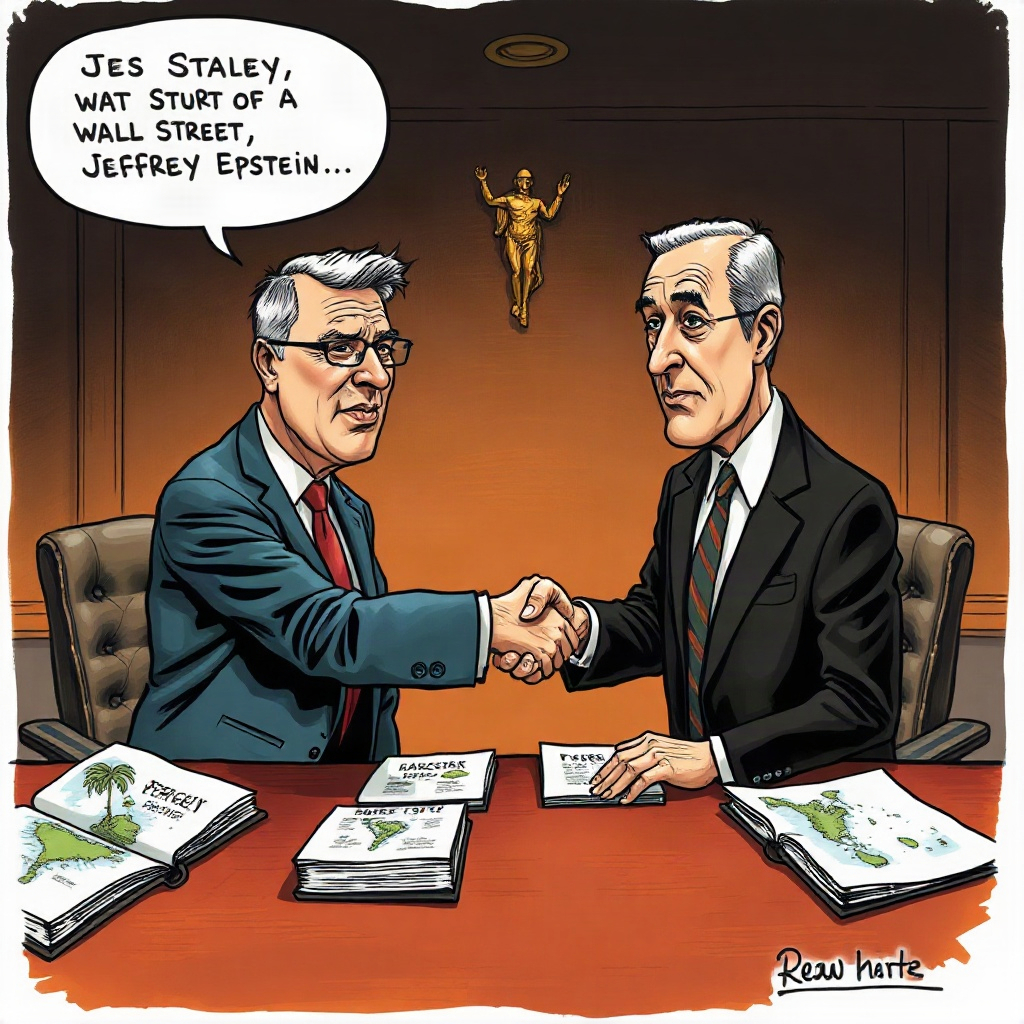
Jes Staley · Former CEO, Barclays
For decades, the global financial system maintained a guarded posture toward the private affairs of its most lucrative clients. Few trajectories illustrate the vulnerabilities and moral compromises of that era more starkly than the relationship between Jeffrey Epstein and James Edward 'Jes' Staley. Staley, an American banking executive who climbed the ranks of JPMorgan Chase to lead its private banking and asset management divisions before ultimately serving as the chief executive officer of Barclays, developed a deep and durable association with Epstein that outlasted criminal convictions, compliance red flags, and basic institutional prudence. Through court filings, regulatory enforcement actions, and disclosed electronic communications, public records now offer a granular look into how an elite financier's career became intertwined with a convicted sex offender.
Staley's relationship with Epstein began in the early 2000s when Staley led JPMorgan's private banking division, an elite arm of the institution dedicated to catering to ultra-high-net-worth individuals. Epstein was not merely a wealthy depositor; he functioned as a prolific conduit for new, extraordinarily wealthy clients, introducing billionaires, industrialists, and influential figures into JPMorgan's orbit. In return, Staley and the bank afforded Epstein an extraordinary degree of deference, granting him direct access to senior leadership and shielding his accounts from routine compliance pressures. Internal documents released in subsequent civil litigation indicate that Epstein was considered by bank leadership to be one of their most valuable relationships, generating tens of millions of dollars in fees across investment and depository accounts.
The relationship did not dissolve following Epstein's 2006 arrest or his 2008 conviction in Florida on state charges of procuring a minor for prostitution. To the contrary, public records and legal discovery documents demonstrate that Staley continued his personal and professional interactions with Epstein during and after his incarceration. Internal emails produced in federal court revealed that Staley visited Epstein during his restricted work-release program in Florida and maintained frequent written correspondence with him across personal and corporate accounts. Even as compliance officers within JPMorgan flagged suspicious cash withdrawals and questioned the legal risks of retaining Epstein as a client, Staley and other senior figures resisted offboarding him. It was not until 2013, around the time Staley departed the bank to join the hedge fund BlueMountain Capital Management, that JPMorgan finally severed its formal banking ties with Epstein.
Related articles

Jeffrey Epstein and Marvin Minsky
An investigative look into AI pioneer Marvin Minsky's documented ties to Jeffrey Epstein and the unsealed 2019 defamation court filings.
Read article →
Jeffrey Epstein and Joi Ito
Investigative report on Joi Ito's ties to Jeffrey Epstein, detailing secret MIT Media Lab funding, personal investments, and the 2019 fallout.
Read article →

Jeffrey Epstein and George Church
Investigative review of geneticist George Church's financial and professional interactions with Jeffrey Epstein across nearly two decades.
Read article →

Jeffrey Epstein and Martin Nowak
Investigative report on Harvard biologist Martin Nowak, his ties to Jeffrey Epstein, university funding, and subsequent disciplinary sanctions.
Read article →