Key Facts
53 pages
Draft Federal Indictment Length
DOJ OPR Report (2020)
13 months with daily work release
State Custody Served
Palm Beach County Sheriff's Office Records
Violated the Crime Victims' Rights Act (CVRA)
Judicial Finding
Judge Kenneth Marra Ruling (2019)
Exercised poor judgment without criminal misconduct
DOJ OPR Finding
DOJ Office of Professional Responsibility (2020)
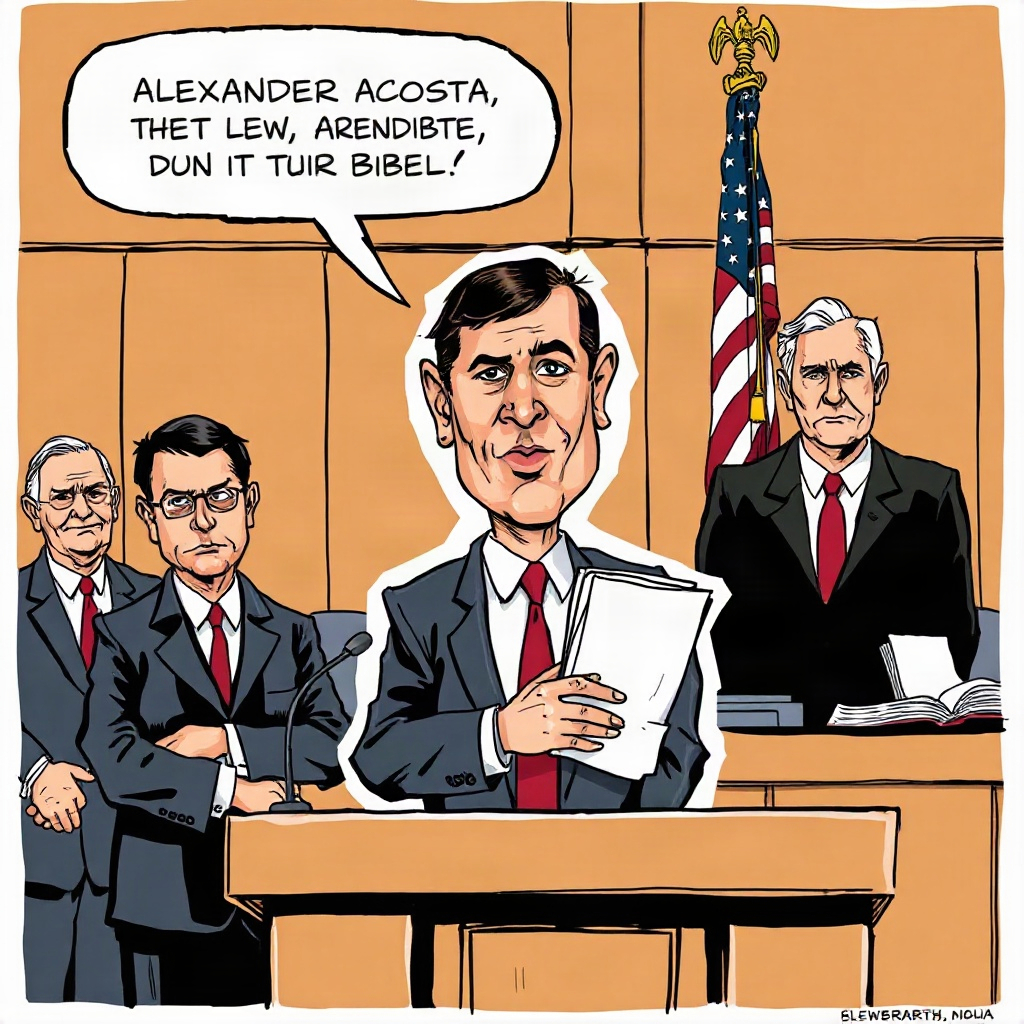
Alexander Acosta · Former U.S. Secretary of Labor
In the extensive archival record surrounding Jeffrey Epstein, few public officials occupy a more consequential role than R. Alexander Acosta. As the United States Attorney for the Southern District of Florida from 2005 to 2009, Acosta presided over the federal response to a sprawling local investigation into Epstein's sexual abuse of minors in Palm Beach. The resolution orchestrated under his authority—a confidential 2007 Non-Prosecution Agreement that shielded Epstein and potential co-conspirators from federal indictment—remains one of the most scrutinized prosecutorial decisions in modern American legal history. The agreement not only allowed Epstein to evade federal charges for more than a decade, but it also catalyzed Acosta's eventual resignation as United States Secretary of Labor in July 2019.
Acosta arrived at the U.S. Attorney's Office in Miami with sterling conservative credentials. A graduate of Harvard College and Harvard Law School, he had clerked for Supreme Court Justice Samuel Alito, served on the National Labor Relations Board, and led the Justice Department's Civil Rights Division. When Palm Beach Police Chief Michael Reiter presented federal authorities with a meticulous dossier in 2006 alleging that Epstein had engaged in serial sexual abuse and trafficking of teenage girls, federal prosecutors in the Southern District initiated an independent grand jury investigation. Internal Justice Department files, later examined by government watchdogs and investigative reporters, reveal that Miami prosecutors prepared an extensive 53-page draft indictment detailing federal sex trafficking and conspiracy charges carrying mandatory prison time.
Faced with catastrophic exposure, Epstein assembled an elite defense team that included prominent litigators Kenneth Starr, Roy Black, Alan Dershowitz, and Jay Lefkowitz. Public records and court exhibits indicate that defense counsel engaged in an aggressive lobbying campaign targeting both local prosecutors and senior Justice Department officials in Washington. The defense team pushed for an unprecedented federal deferral to state authorities, contending that the conduct, while improper, was fundamentally local in scope. Internal communications released in subsequent litigation show that Acosta met personally with Epstein's attorneys in late 2007, bypassing line prosecutors who had advocated for proceeding with the federal indictment.
In September 2007, Acosta formally approved the secret Non-Prosecution Agreement. Under the terms of the agreement, the federal government promised to abandon its grand jury investigation in exchange for Epstein pleading guilty to two state-level charges in Florida: one count of felony solicitation of prostitution and one count of procuring a person under 18 for prostitution. The deal went far beyond typical prosecutorial compromises by granting sweeping federal immunity not only to Epstein, but also to any potential unindicted co-conspirators. Perhaps most controversially, the agreement was executed without the knowledge or consent of the dozens of identified victims, and federal prosecutors agreed to keep the existence of the non-prosecution deal concealed from the survivors.
Related articles
Jeffrey Epstein and Marvin Minsky
An investigative look into AI pioneer Marvin Minsky's documented ties to Jeffrey Epstein and the unsealed 2019 defamation court filings.
Read article →
Jeffrey Epstein and Joi Ito
Investigative report on Joi Ito's ties to Jeffrey Epstein, detailing secret MIT Media Lab funding, personal investments, and the 2019 fallout.
Read article →
Jeffrey Epstein and George Church
Investigative review of geneticist George Church's financial and professional interactions with Jeffrey Epstein across nearly two decades.
Read article →
Jeffrey Epstein and Martin Nowak
Investigative report on Harvard biologist Martin Nowak, his ties to Jeffrey Epstein, university funding, and subsequent disciplinary sanctions.
Read article →