Key Facts
Listed in Epstein's 97-page personal contact directory ('Black Book')
Documentary Link
Palm Beach Police Department (2006)
No record of travel on Epstein's aircraft across public flight manifests
Flight Log Presence
Giuffre v. Maxwell Flight Logs
Never accused of criminal wrongdoing or misconduct involving Epstein
Legal Status
SDNY Indictment (2019)
Both held associations with elite foreign policy forums including the Council on Foreign Relations
Shared Institutional Ties
CFR Membership Records
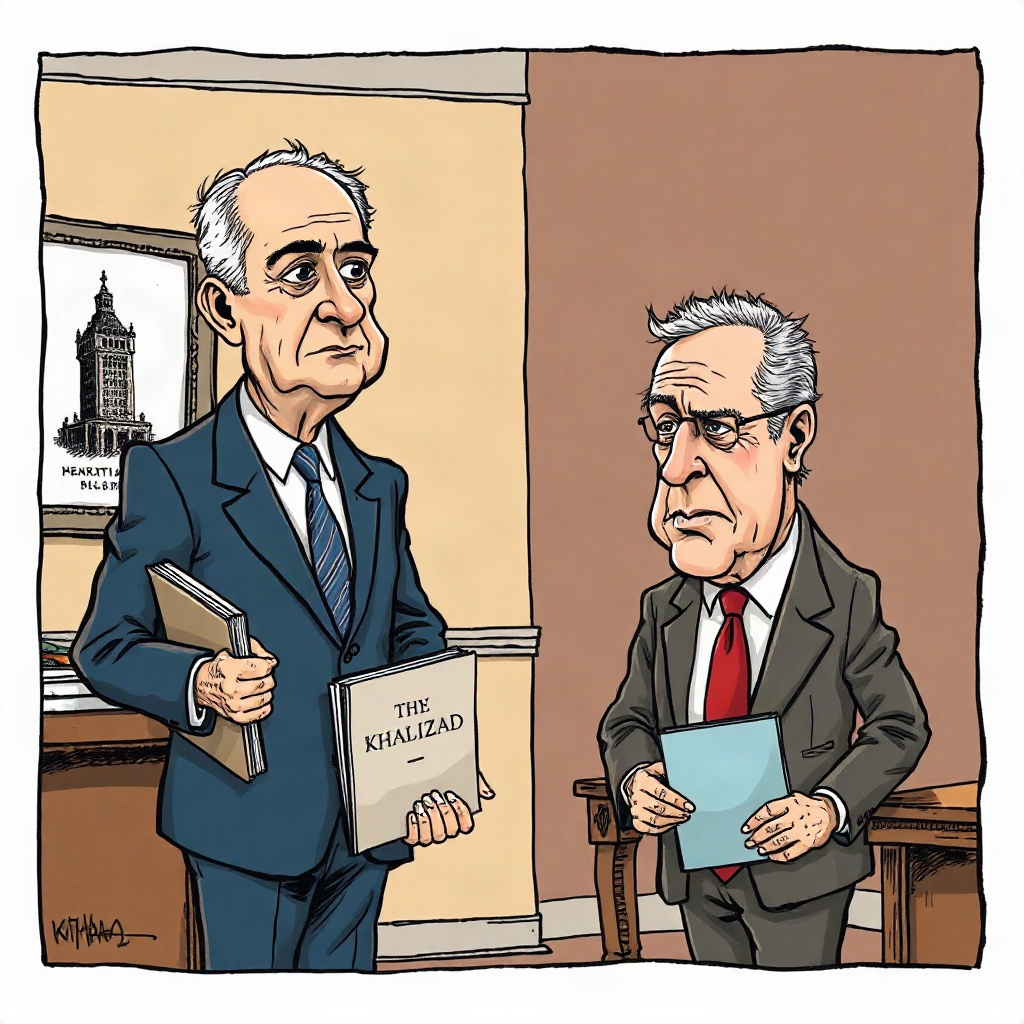
Zalmay Khalilzad · Former US Ambassador to the UN
In the sprawling web of political figures, financiers, and international power brokers assembled by Jeffrey Epstein, few categories received as much deliberate attention as the American national security and foreign policy establishment. Among the high-ranking diplomatic officials whose contact information was captured within Epstein’s personal archives was Zalmay Khalilzad, one of the most prominent U.S. diplomats of the post-September 11 era. Khalilzad’s inclusion in Epstein’s records reflects a persistent pattern in the financier’s social climbing: the systematic acquisition of access to officials directing American foreign policy, international diplomacy, and strategic statecraft.
Zalmay Khalilzad built a decades-long career as a leading architect of American foreign policy in the Middle East and Central Asia. Born in Mazar-i-Sharif, Afghanistan, Khalilzad rose through the ranks of Washington think tanks and government agencies, serving under Presidents Ronald Reagan, George H.W. Bush, and George W. Bush. In the aftermath of the 2001 invasion of Afghanistan, Khalilzad served successively as the United States Ambassador to Afghanistan, Ambassador to Iraq, and ultimately as the United States Permanent Representative to the United Nations from 2007 to 2009. Years later, he was appointed Special Representative for Afghanistan Reconciliation under the Trump and Biden administrations, negotiating the 2020 Doha Agreement with the Taliban. Throughout his career, Khalilzad was a fixture of both official Washington and elite global policy networks.
The documentary record connecting Epstein to Khalilzad derives primarily from Epstein’s personal contact directory, commonly referred to as his black book. Compiled in the mid-2000s by Epstein’s household staff and later seized by the Palm Beach Police Department during their initial 2005–2006 investigation, the 97-page binder contained contact information for thousands of prominent figures. When an annotated version of the directory was published by investigative journalists in 2015, Khalilzad was listed among the entries. The listing included direct phone numbers, reflecting that Epstein’s office maintained active access to Khalilzad during a period when the diplomat was occupying critical roles in the Bush administration’s national security apparatus.
Related articles
Jeffrey Epstein and Thorbjørn Jagland
Investigative report examining the diplomatic meetings between Jeffrey Epstein and former Norwegian Prime Minister Thorbjørn Jagland in 2013.
Read article →
Jeffrey Epstein and Terje Rød-Larsen
Investigative review of Norwegian diplomat Terje Rød-Larsen's ties to Jeffrey Epstein, detailing secret loans, institutional funding, and his resignation.
Read article →

Jeffrey Epstein and Mona Juul
Investigative report examining Norwegian diplomat Mona Juul's documented social ties to Jeffrey Epstein through her husband, Terje Rød-Larsen.
Read article →

Jeffrey Epstein and Andrés Pastrana
Investigative examination of former Colombian President Andrés Pastrana's documented flights on Jeffrey Epstein's aircraft and related unsealed records.
Read article →